Exposure Management: AI Is Now Required

When a critical vulnerability emerges actively exploited, high severity, externally reachable, business-relevant, or otherwise likely to demand emergency attention security teams move quickly.
Priority 0 vulnerability workflow
What does the typical workflow for a zero-day or one-day vulnerability look like? A Slack message goes out and someone queries the CMDB. Threat intelligence is pasted into a channel while emails are sent to technology owners to validate whether the technology is in use. Scanner data is checked, challenged, and checked again.
In a large and mature organization, experienced exposure management teams can use this model to reach a reasonably good triage decision in two hours. They know the environment, they know who to call, and they can usually assemble enough evidence to determine whether emergency action is required.
But that model is not built for the Mythos era.
The Mythos era
Anthropic's Mythos and the next generation of AI models that are coming lower attack friction and increases attack speed, and it changes the defender’s time horizon. If organizations want to move toward patching or mitigation within 12 hours, or even 6 hours, they cannot afford a process that depends on manual coordination, ad hoc data calls, undefined decision paths, or unclear escalation triggers.
Exposure management teams often have the data they need: asset inventories, scan results, CMDB records, software inventories, EDR telemetry, firewall data, application ownership, internet exposure context, business criticality, and threat intelligence. The problem is not the absence of data. The problem is the orchestration of data, expertise, decisions, triggers, and authorities under time pressure.
A manual process, even with elements of automation, may be good enough when the organization is dealing with one urgent vulnerability at a time. It does not meet the demands of the Mythos era. It becomes fragile when several critical vulnerabilities need to be assessed in parallel, when key evidence sources are delayed, or when the business expects credible triage and remediation planning within hours.
It also introduces unnecessary variance. In many organizations, triage responsibility rotates across analysts, incident leads, infrastructure teams, and application owners. Without a defined decision workflow, similar vulnerabilities can be assessed differently depending on who is online, who knows the platform best, who has the strongest relationships with technology teams, or who is most comfortable escalating on incomplete evidence.
Agentic AI decision support
Agentic AI decision support does not eliminate judgment; it standardizes the conditions under which judgment is applied and humans remain in the loop.
That matters because Priority 0 triage is not just a data-retrieval problem. It is a sequencing problem. The organization needs to determine whether the affected technology is present, whether it is exposed, whether exploitation is plausible or confirmed, whether business-critical services are implicated, what mitigations are available, what uncertainty remains, and who has the authority to approve the classification and response.
Agentic AI can help structure that workflow. It can bring the right evidence into the decision path, identify missing or conflicting data, prompt the right teams at the right time, track confidence levels, and recommend next actions based on predefined criteria. This enables speed, consistency, scalability, and adherence to process.
Defensibility and Continuous Learning
It also creates a defensible record. Each triage decision can show what evidence was reviewed, which sources were complete, which were missing, what assumptions were made, what uncertainty remained, and who approved the classification.
That record becomes a learning platform. Because each triage captures evidence, gaps, confidence levels, escalations, timelines, and final approvals, the organization can identify recurring data-quality issues, slow evidence sources, inconsistent judgments, and avoidable delays. The process improves because the process leaves a trail.
The goal is not to replace expert judgment. It is to reduce the amount of expert time spent reconstructing the same workflow under pressure, and to make the resulting decision faster, more consistent, more defensible, and easier to improve.
That matters for speed, but it also matters for accountability. Priority 0 decisions can trigger emergency change, executive escalation, customer impact analysis, regulatory discussions, business disruption, compensating-control decisions, and formal risk acceptance. The organization needs to be able to explain not only what it decided, but why the decision was reasonable based on the evidence available at the time.
Decision Support mock-up
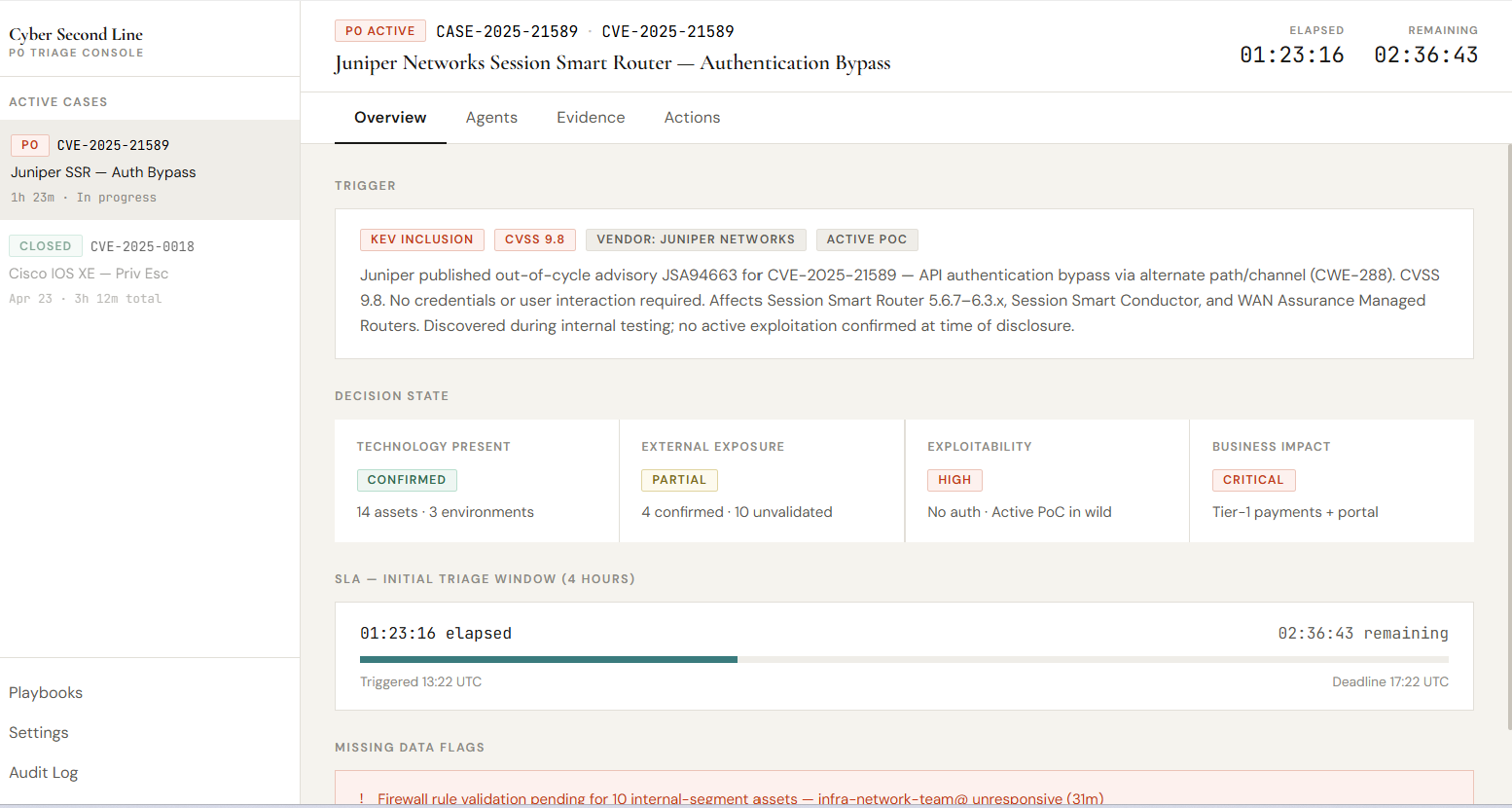
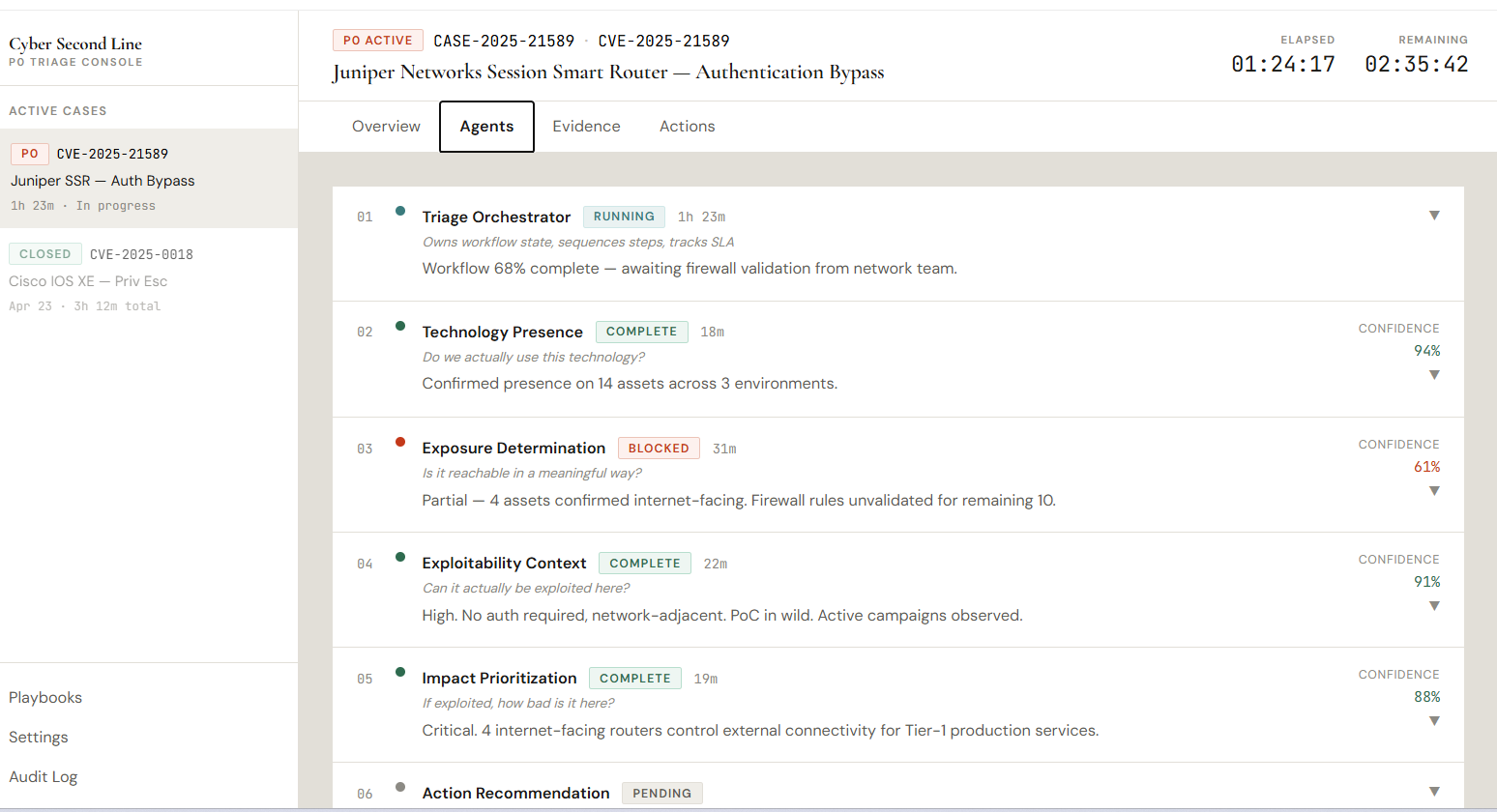
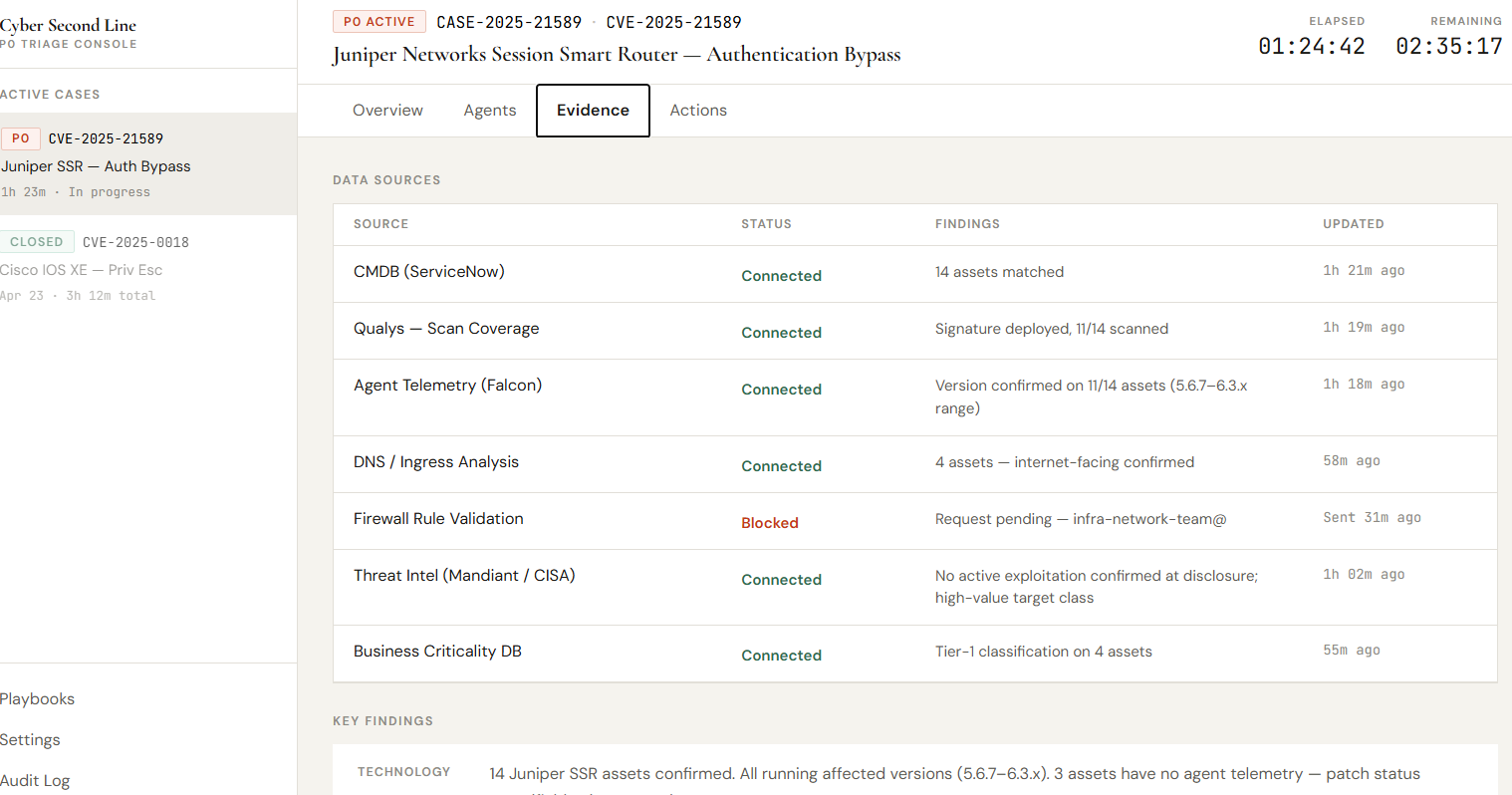
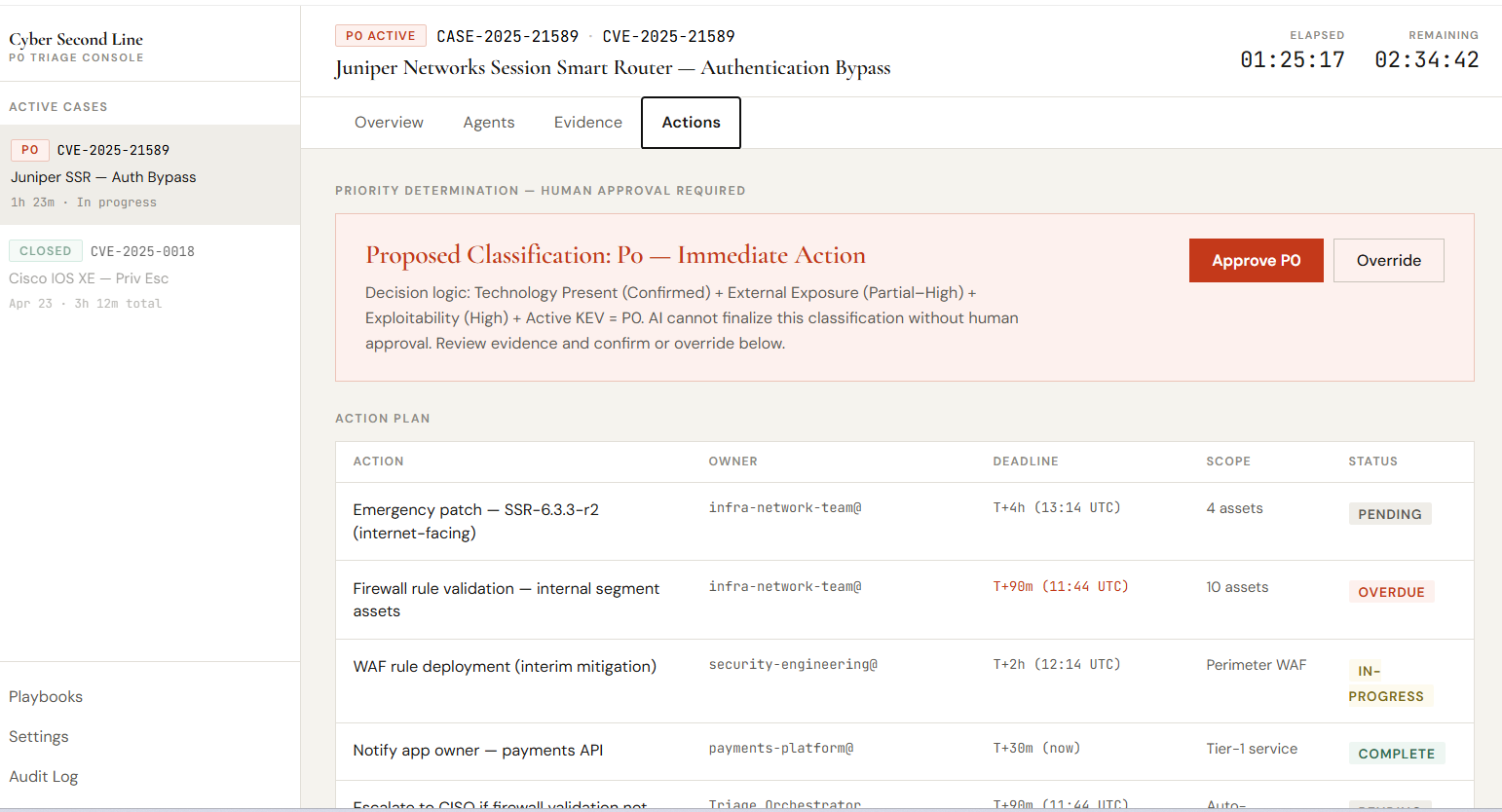
The diagrams below show a mock-up of an agentic Priority 0 triage workflow.
The system sequences the early decision path: whether the affected technology is present, whether it is externally exposed, whether exploitation is plausible or confirmed, whether business-critical services are implicated, and what action should be recommended. At the same time, it tracks evidence quality, confidence levels, blocked data sources, ownership, SLA pressure, and required approvals.